
N19 · aerial repairs & installation
TV aerial repairs and installation in Archway
Archway combines steep Victorian terraces with tall estate blocks, so we're as likely to be testing a communal riser here as lashing an aerial to a chimney.
- N19
- Same-day repairs
- Established 1997
N19
Local postcode
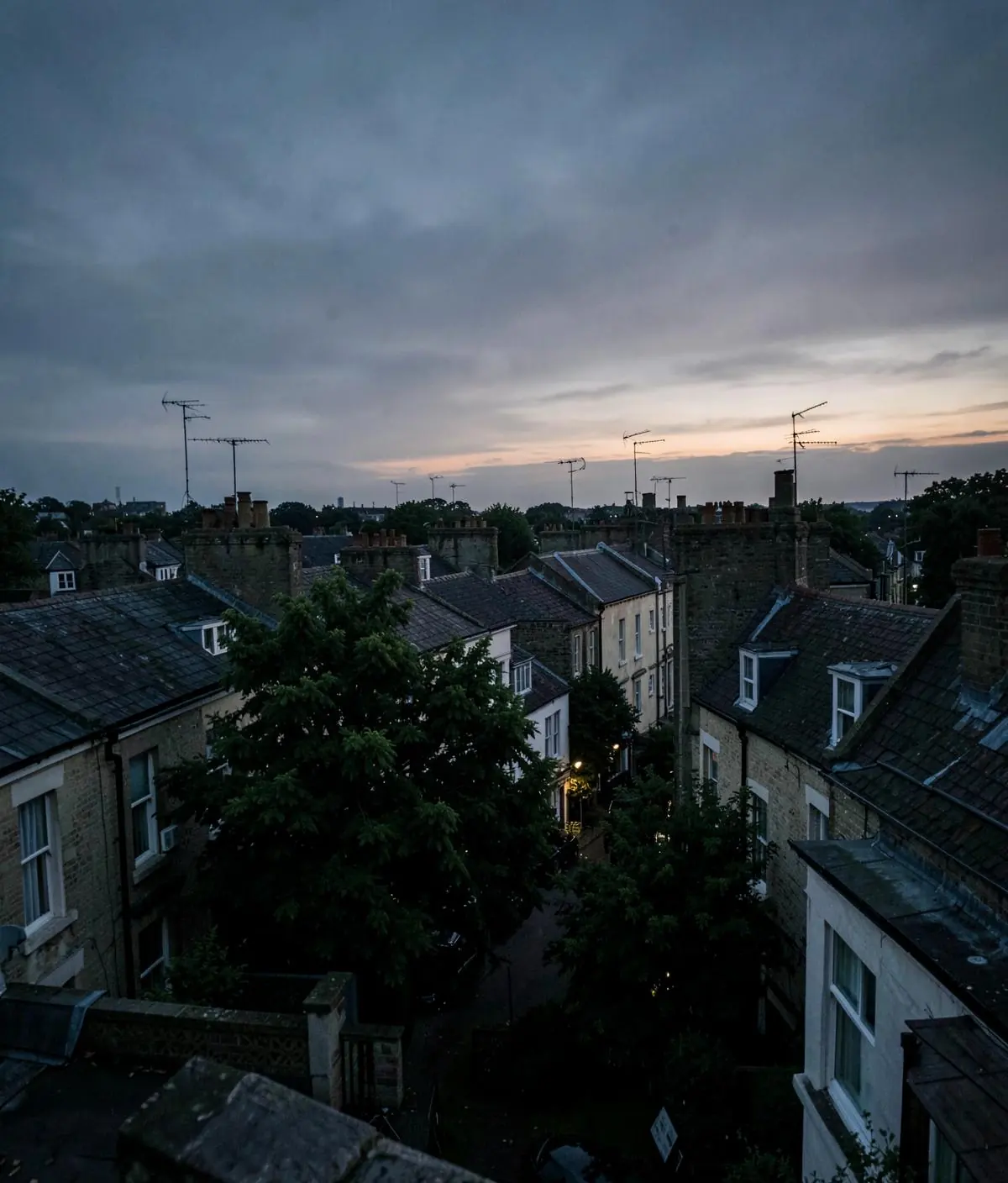
Terraces and tower blocks around Archway
The climb up toward Highgate Hill gives a real spread of reception conditions across a short distance, and the tall blocks around Archway itself both shadow and reflect signal for the streets behind them. Metering on your own roof is the only way to settle what aerial is appropriate.
In the blocks, communal systems and riser cabling do most of the work, and faults tend to affect a run of flats rather than a single one. We test at the head end and at floor distribution, report to the agent, and fix the specific failure.
The terraces along the hill are typically converted, so distribution and outlet quality often matter more than the aerial. We prove the indoor side before recommending anything at roof level.
Aerial work in Archway
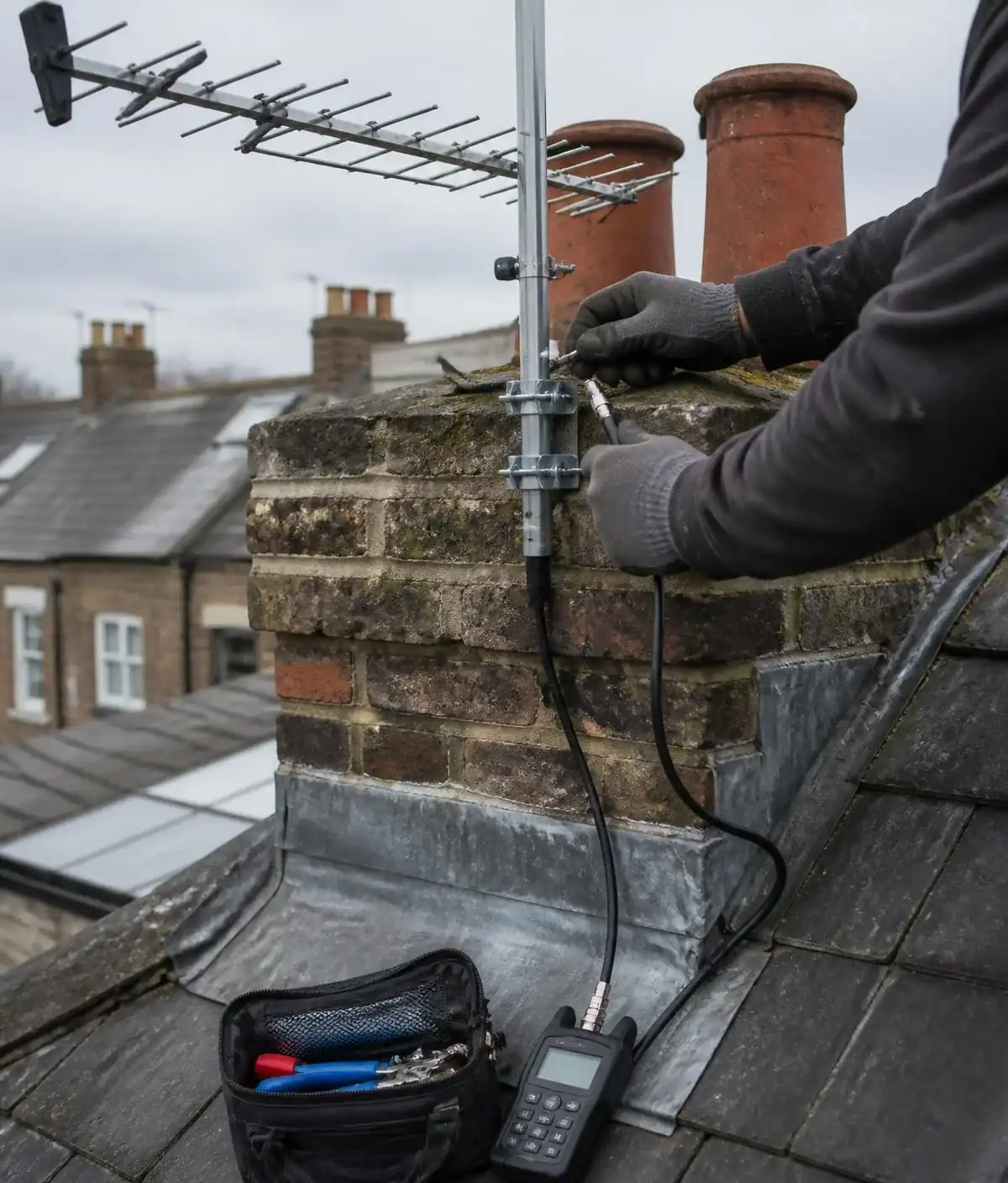
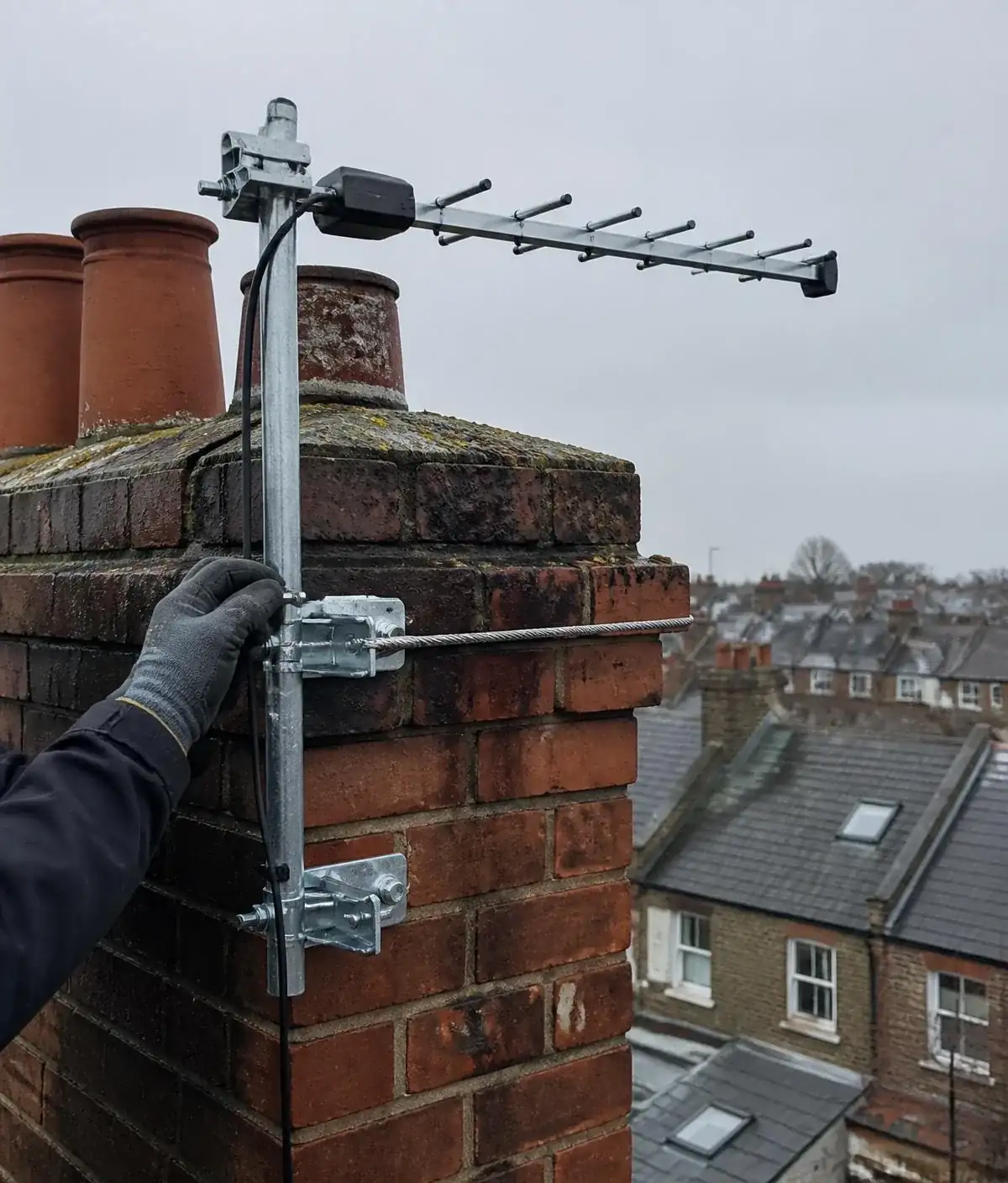
What careful roof work looks like in Archway
Streets and pockets we work in
Familiar ground in Archway
- Highgate Hill
- Junction Road
- Holloway Road
- Archway Road
- St John's Way
- Dartmouth Park Hill
- Elthorne Road
- Girdlestone Walk
Aerial repairs and everything else we do here
Aerial repairs
Storm damage, snapped elements, sagging poles and corroded connections put right.
Satellite repairs
No signal, rain fade and failed LNBs traced and repaired on the first visit.
TV signal problems
Pixelation, missing channels and picture that drops at the same time each evening.
TV aerial installation
New wideband or high-gain aerials sited for a clean Crystal Palace signal.
Extra TV points
New aerial or satellite outlets in bedrooms, kitchens, lofts and garden rooms.
Satellite dish installation
New dishes aligned on a meter, from single feeds to multi-room quad LNBs.
Foreign language satellite
European, Arabic, Turkish, Asian and Polish satellite systems installed and aligned.
TV wall mounting
Televisions mounted level and secure, with cables hidden inside the wall.
Home WiFi installation
Dead spots surveyed and fixed properly, not papered over with plug-in extenders.
CCTV installation & repair
CCTV repairs, camera and recorder faults fixed, plus new systems positioned for useful footage.
Smart home in Archway
Smart home security
Cameras, alarms, intercom and door access working together, viewable from anywhere.
Whole-home control
Lighting, blinds, heating, music, TV and security on one app and one set of keypads.
Roofs, streets and reception in Archway
What Archway property means for your aerial
Archway is where the flat ground around Holloway Road meets the steep climb up Highgate Hill, and that change in elevation across a short distance is the single biggest factor in how we approach reception work here. Junction Road and Holloway Road carry mostly Victorian terraces converted into flats, while the area around Archway itself and along St John's Way includes a number of taller estate and mansion blocks whose height both shadows the streets immediately behind them and reflects signal in ways that can cause ghosting or interference for neighbouring roofs. Further up Highgate Hill and around Dartmouth Park Hill, houses sit progressively higher with generally clearer paths towards Crystal Palace, while properties tucked behind the taller blocks nearer Archway tube can be surprisingly marginal despite being only a short walk away.
The tall blocks around Archway change the local signal picture street by street rather than by any simple rule, since a building that shadows one row of houses can reflect a usable signal onto another at a slightly different angle — which is why a reading taken on one roof genuinely doesn't predict the result on the next street over. We always meter at the specific property before recommending an aerial type, and on the terraces most affected by nearby blocks a higher mounting position clear of the immediate roofline, rather than a bigger aerial, is usually what resolves it.
Estate and mansion blocks in this area generally run on communal systems with a head-end on the roof and cabling distributed down through risers to each flat, and when something goes wrong it typically affects a run of flats on the same riser rather than one flat in isolation, which is a useful diagnostic clue in itself. We test at the head end and at a sample of floor outlets before quoting any repair, since a fault reported by several residents in the same stack is often one bad connection or ageing amplifier rather than several separate problems needing separate call-outs.
The Victorian terraces climbing Highgate Hill and around Elthorne Road and Girdlestone Walk are mostly converted into flats, and here the aerial on the roof is frequently in reasonable condition while the internal distribution let down the picture — old coax runs, unpowered splitters shared between floors, and outlets added piecemeal as flats changed hands over the years. We prove the indoor wiring and distribution before recommending any work at roof level, since replacing a perfectly good aerial rarely fixes a problem that's actually sitting in the cabling between the roof and the television.
Aerial repairs we do most in Archway
Archway faults and what actually causes them
Ghosting or a doubled picture on streets near the taller blocks
signal reflecting off a nearby tall building alongside the direct signal from Crystal Palace
Several flats on the same floor or riser losing signal together
a single failed connection or ageing amplifier in the communal riser system
Reception that varies sharply between two nearby streets
shadowing from a tall block affecting one row of roofs but not the next
Weak picture in a converted terrace despite a sound aerial
old, unpowered internal cabling shared across several flats
Aerial performance dropping after nearby building work
scaffolding or new construction temporarily altering the reflected signal path
Installation notes for Archway
- Individual roof-level metering used throughout, since reflection and shadowing from tall blocks vary sharply between neighbouring streets
- Higher mounting positions favoured over bigger aerials where a nearby block is the cause of a weak signal
- Communal riser systems tested at the head end and at floor level before any repair is authorised
- Indoor cabling and distribution checked and proven first in converted terraces before touching the roof aerial
- Readings taken after any nearby scaffolding or construction work that may have altered the local signal path
Archway questions
Archway answers, not call-centre scripts
Several flats on my floor lost channels. What causes that?
Typically a failed amplifier or a corroded connection in the riser serving that run of flats. We test at the floor distribution point to confirm.
Does the tall block next door affect my reception?
It can, by blocking the path or creating reflections. Changing the aerial type or mounting position usually resolves it.
Do you cover Dartmouth Park and Tufnell Park?
Yes, along with Upper Holloway and the streets running up Highgate Hill.
Why does my street get worse reception than one just around the corner?
Archway's mix of tall blocks and steep ground means shadowing and reflection can affect one row of houses quite differently from the next street over. We meter each property individually rather than assuming a result from nearby streets.
Several flats in my block have lost signal at once — is that a coincidence?
Usually not. Estate and mansion blocks here typically run on a shared riser system, so a fault affecting several flats on the same floor or stack often traces back to one failed connection or amplifier rather than separate faults in each flat.
Does living higher up Highgate Hill mean better reception automatically?
Generally the path improves with height going up the hill, but it isn't guaranteed — some higher properties are still affected by nearby buildings or trees, so we still take a reading on the specific roof rather than assuming height alone settles it.
My aerial looks fine but the picture is still poor — what else could it be?
In the area's many converted terraces, ageing or overloaded internal cabling is a very common cause even when the aerial itself is in good condition. We test the indoor distribution before recommending any work at roof level.
Nearby areas
We cover the same streets for security work too — CCTV repairs and installation in Archway.
Free advice, no obligation
Describe the fault. We'll tell you what your Archway aerial needs.
Speak to an engineer on WhatsApp — Mon–Sat 8am–8pm, Sun 9am–5pm. We cover North & North West London and most jobs are finished in a single visit.