NW3 · aerial repairs & installation
TV aerial repairs and installation in Hampstead
Hampstead is our home ground. We know which streets sit in the shadow of the Heath's tree line, which chimney stacks won't take a lashing kit, and where a conservation officer would rather not see a new aerial.
- NW3
- Same-day repairs
- Established 1997
NW3
Local postcode
Aerial and satellite work on Hampstead's hill
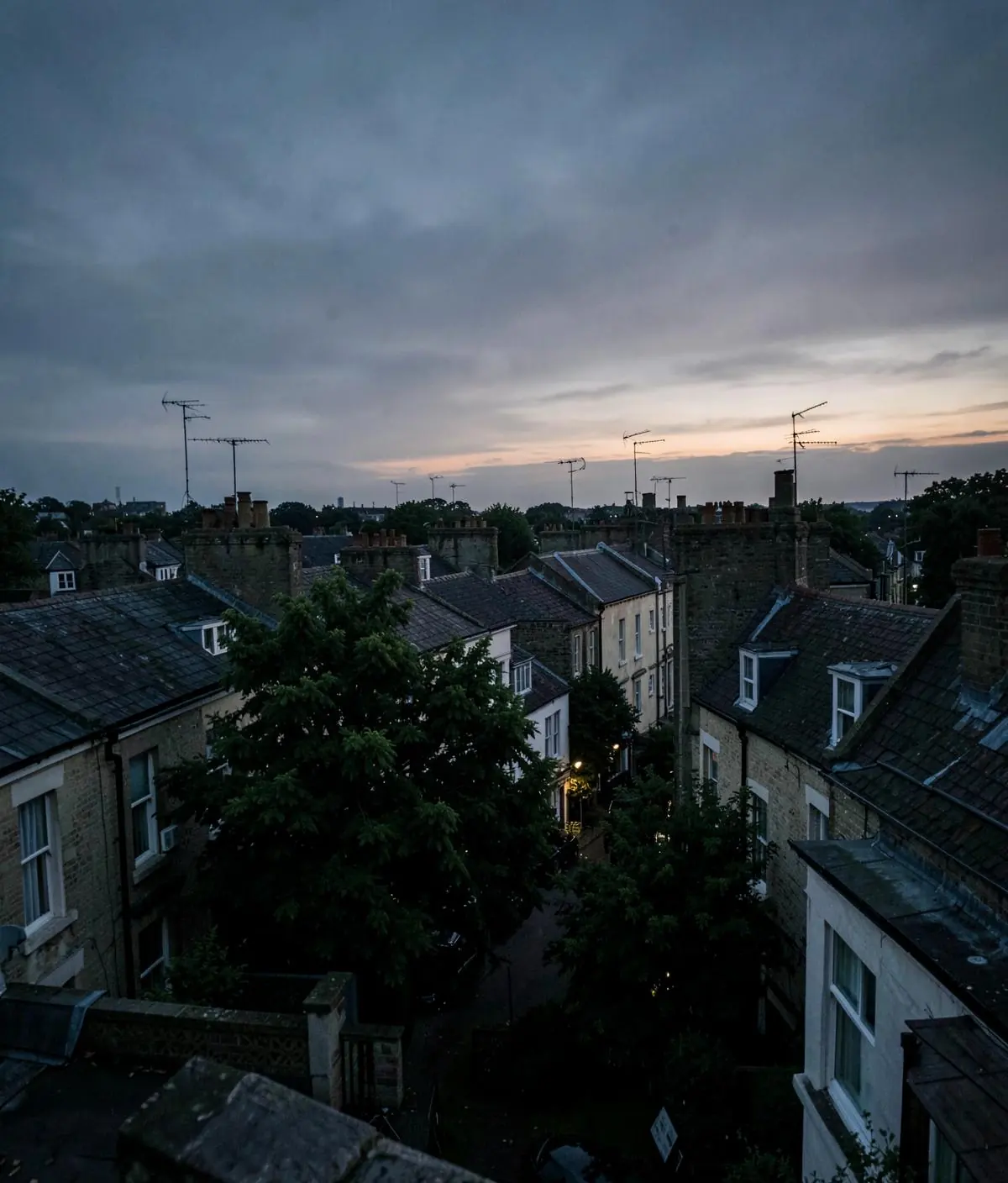
Height ought to help reception, and often it does — but Hampstead's elevation comes with dense mature trees, deep back gardens full of limes and planes, and terraces that step steeply so a neighbour's roof can block the very path you need. Two houses on the same road frequently need different aerials, so we always meter at roof level before recommending anything.
Almost all of central Hampstead falls within conservation designations and a great many houses are listed, which shapes how we work. Rear roof slopes, side returns, below-ridge positions and, where the signal allows, loft mounting keep installations off the street elevation. On listed fabric we fix into mortar joints and reuse existing routes rather than making new holes in old brick.
Flats in the big converted villas around Frognal and Fitzjohn's Avenue are a common call. Often the answer isn't a new dish at all but repairing the communal system or sorting the internal distribution, which keeps the freeholder happy and costs you less.
Aerial work in Hampstead
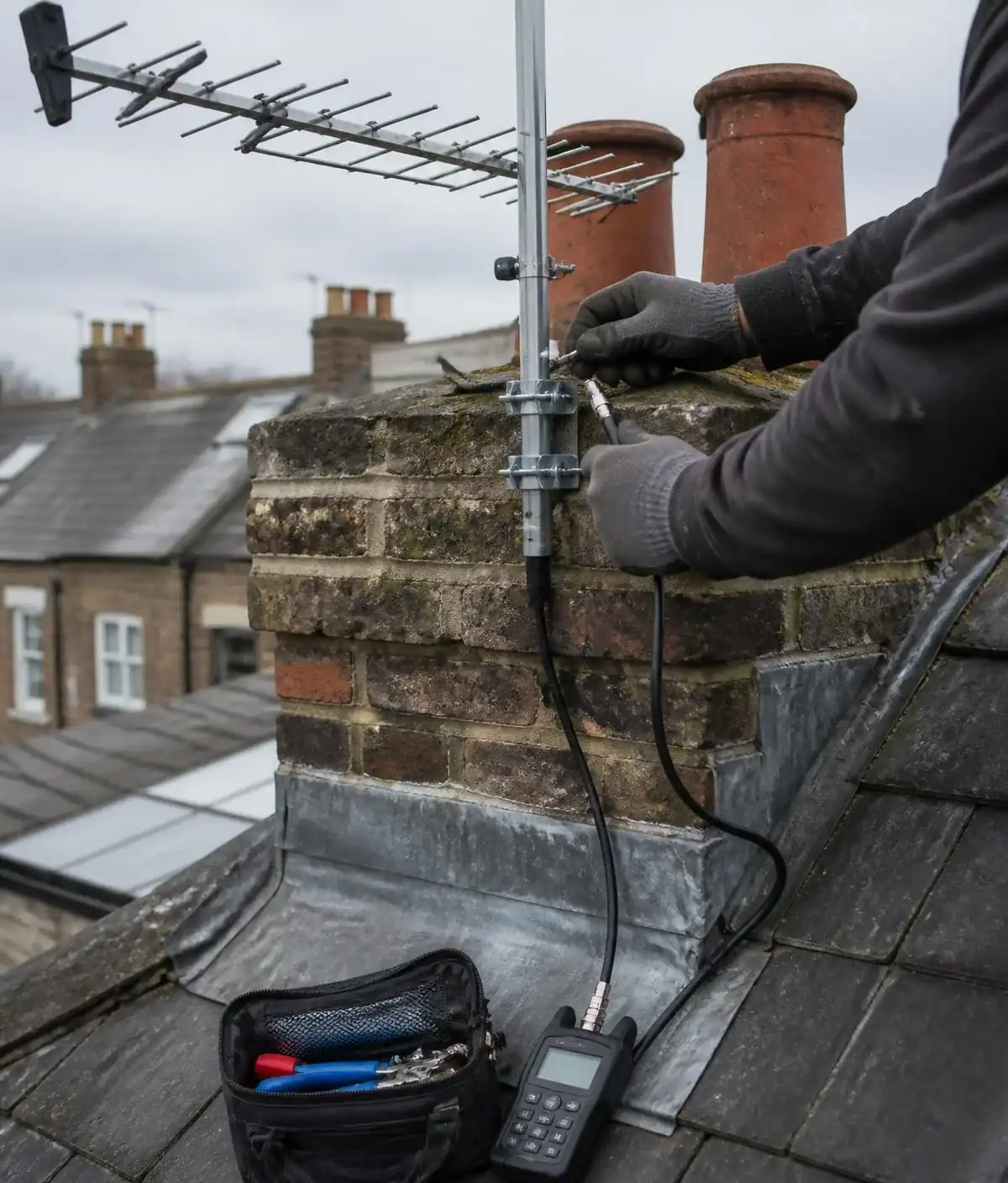
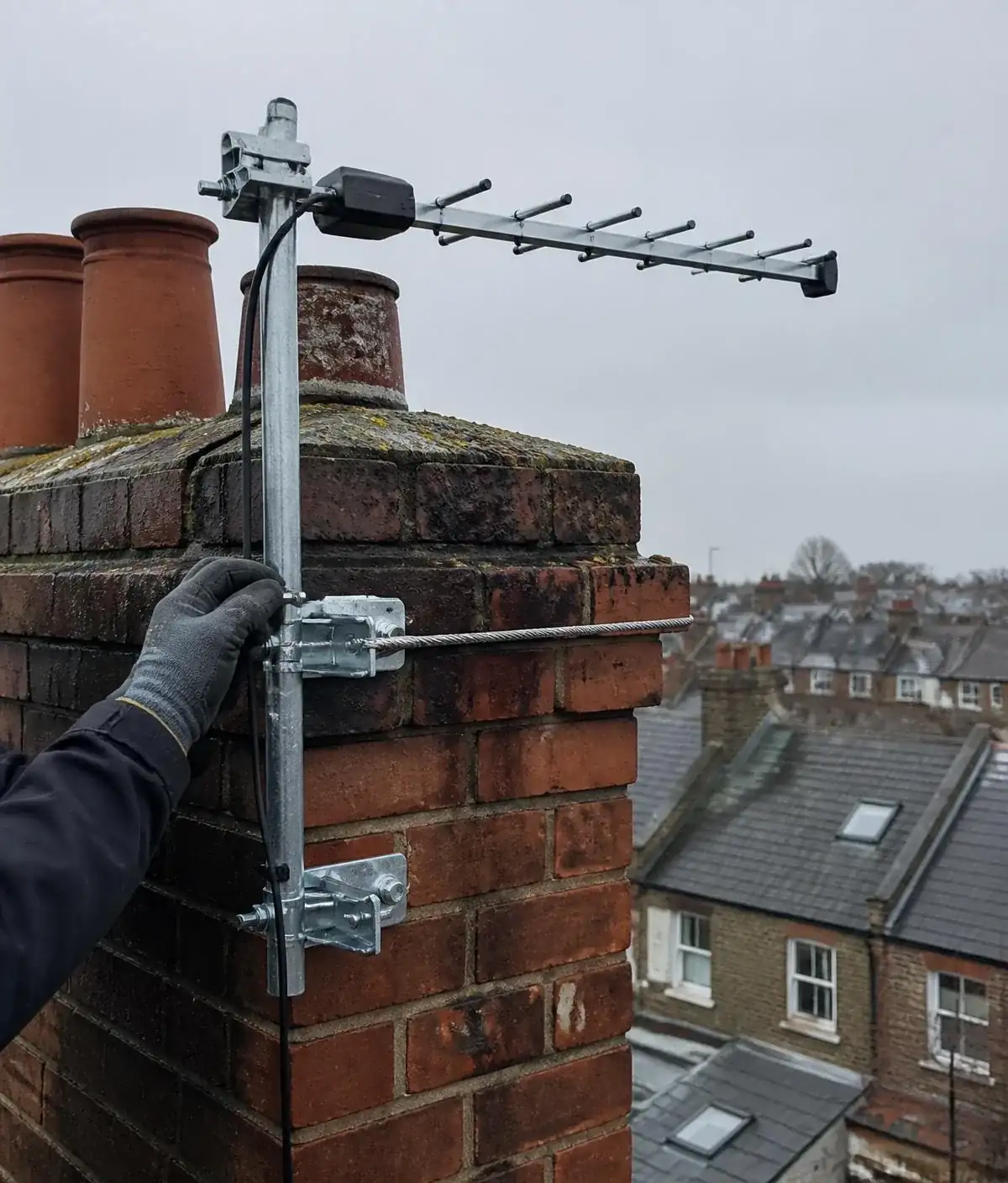
What careful roof work looks like in Hampstead
Streets and pockets we work in
Familiar ground in Hampstead
- Hampstead High Street
- Flask Walk
- Frognal
- Fitzjohn's Avenue
- Well Walk
- Church Row
- Heath Street
- Downshire Hill
- Redington Road
- South End Green
Aerial repairs and everything else we do here
Aerial repairs
Storm damage, snapped elements, sagging poles and corroded connections put right.
Satellite repairs
No signal, rain fade and failed LNBs traced and repaired on the first visit.
TV signal problems
Pixelation, missing channels and picture that drops at the same time each evening.
TV aerial installation
New wideband or high-gain aerials sited for a clean Crystal Palace signal.
Extra TV points
New aerial or satellite outlets in bedrooms, kitchens, lofts and garden rooms.
Satellite dish installation
New dishes aligned on a meter, from single feeds to multi-room quad LNBs.
Foreign language satellite
European, Arabic, Turkish, Asian and Polish satellite systems installed and aligned.
TV wall mounting
Televisions mounted level and secure, with cables hidden inside the wall.
Home WiFi installation
Dead spots surveyed and fixed properly, not papered over with plug-in extenders.
CCTV installation & repair
CCTV repairs, camera and recorder faults fixed, plus new systems positioned for useful footage.
Smart home in Hampstead
Smart home security
Cameras, alarms, intercom and door access working together, viewable from anywhere.
Whole-home control
Lighting, blinds, heating, music, TV and security on one app and one set of keypads.
Roofs, streets and reception in Hampstead
What Hampstead property means for your aerial
Reception across Hampstead comes almost entirely off Crystal Palace, but the path from a south-facing chimney on Church Row is a very different proposition to a north-facing rear slope on the far side of Christchurch Hill, where the Heath's tree canopy and the rise of the hill itself sit between the roof and the transmitter. Slate is the dominant roof covering on the older Victorian terraces, with London stock brick chimney stacks that have often taken decades of pointing repairs, while the villas on Frognal and Redington Road tend towards clay tile and generous loft voids that make internal aerial mounting a realistic option where an external fixing would be awkward. Satellite dishes on the taller houses need a clear line south-south-east towards 28.2 degrees east for Sky and Freesat, and the closer, steeper terraces sometimes lose that path behind a neighbour's roofline long before any tree gets in the way.
Chimney stacks on the older terraces off Flask Walk and Well Walk have generally stood since before television aerials existed, so before fitting any bracket and lashing kit we check the pot, the flaunching and the brickwork for movement rather than assuming the stack will simply take the load. A stack with frost-damaged coping or loose rendering isn't a safe fixing point regardless of how good the reception would be from up there, and on those we'll either strengthen the fixing with a wall-mounted bracket lower down or move to a loft-mounted aerial if the roof covering and signal strength allow it. Lashing kits themselves need checking every few years too, since the wire ties that hold an aerial pole to a chimney can work loose or corrode, and a surprising number of the callouts we get for a suddenly pixelating picture turn out to be nothing more than a slipped mast rather than a failed aerial.
Tree cover is the single biggest variable in this postcode. The plane and lime trees along Well Walk and the mature gardens backing onto the Heath put a lot of moving foliage into the signal path during the summer months, and because wet leaves absorb UHF far more than bare winter branches, a picture that's rock solid in January can start breaking up by June on exactly the same aerial. We deal with this by aiming for more signal margin than the winter reading alone would suggest is necessary, sometimes stepping up from a standard aerial to a high-gain model, and by avoiding positions that look clear on a still February morning but sit directly behind a tree canopy once it's in full leaf.
The converted villas around Fitzjohn's Avenue and Redington Road generally run a shared IRS or communal coaxial system serving each flat, installed at conversion and extended piecemeal since, and a fault reported by one resident is very often traceable to a splitter or amplifier in a communal riser cupboard rather than anything wrong in the flat itself. Because so much of this area sits in a conservation area with a good number of listed buildings, cable for both aerials and dishes is run through existing ducts, redundant chimney flues or beneath floorboards wherever possible rather than surface-clipped across a rendered or brick elevation, and dish fixings on flats generally need the freeholder's agreement before anything goes on a shared wall or roof.
Aerial repairs we do most in Hampstead
Hampstead faults and what actually causes them
Sudden onset of pixelation or channel loss after high winds
A lashing kit or pole clamp on an older chimney stack has worked loose, letting the aerial move slightly off the Crystal Palace bearing
Picture breaking up only in summer evenings
Leaf cover on mature trees near the Heath boundary attenuating the UHF signal that was previously clear in winter
One flat losing signal while others in the same converted villa are unaffected
A failing tap or outlet on that flat's branch of the communal distribution system rather than the shared amplifier itself
Freesat or Sky box reporting no signal after a storm
Dish alignment has shifted slightly on an older pole mount, or the LNB has let in moisture over several seasons
Intermittent dropouts on Freeview during the day
A degraded or ageing coax run inside a period house, often original to a much earlier installation and now failing at the connectors
Installation notes for Hampstead
- Rear roof slopes and below-ridge positions are used as standard on the conservation-area terraces, keeping fixings off any elevation visible from the street
- Loft-mounted aerials are considered wherever the roof covering (clay tile rather than slate) and metered signal strength make it viable, avoiding any external fixing at all
- On listed housing stock we fix into existing mortar joints and reuse old routes rather than drilling fresh holes in soft historic brick
- Dish alignment on flats and converted villas is checked against the freeholder's position before any work goes ahead, particularly where a shared roof or wall is involved
- We meter signal at roof height on the specific property rather than assuming a neighbouring house's setup will transfer across, since tree cover and stack height vary house to house
Hampstead questions
Hampstead answers, not call-centre scripts
Can I have an aerial fitted on a listed Hampstead house?
Usually, with careful siting. We aim for rear slopes and below-ridge positions with minimal fixings, and we'll tell you honestly if what you want is likely to need listed building consent first.
Why does my picture get worse in summer?
Leaf cover. Wet foliage absorbs UHF signal, so a path that's clear in February can be marginal in July. We plan around the summer condition rather than the winter one.
Do you cover the streets around the Heath?
Yes — Well Walk, Downshire Hill, South End Green and the roads leading onto the Heath are all everyday territory for us.
Will an aerial on my Hampstead house need listed building consent?
It depends on the fixing and position rather than the aerial itself. A discreet rear-slope or below-ridge aerial fixed into an existing mortar joint very rarely triggers the need for consent, but a prominent front-elevation fixing on a listed house might. We survey first and tell you plainly if we think consent is likely to be needed before any work starts.
Can I get Sky or Freesat if my garden backs onto mature trees?
Usually yes, because the dish needs a clear line to the satellite arc rather than a clear view of the whole sky, and that path is often available from a higher point on the roof or a rear elevation even where the garden itself is heavily wooded. We check the specific sightline on your roof rather than assuming tree cover rules it out.
My flat in a converted Hampstead villa has lost some channels while my neighbour's is fine — what's happening?
That pattern points to something on your own branch of the building's shared aerial system, such as a worn outlet plate or a loose connection behind your own wall point, rather than the communal amplifier serving the whole building. We test at your outlet first, which usually identifies the fault within a short visit.
Do you fit aerials suitable for foreign-language satellite channels here?
Yes. Hotbird at 13 degrees east needs a separate dish or a motorised system distinct from the Sky/Freesat dish aimed at 28.2 degrees east, and on Hampstead's tighter plots finding two clear, discreet sightlines can take some planning, which we do as part of the survey.
Nearby areas
We cover the same streets for security work too — CCTV repairs and installation in Hampstead.
Free advice, no obligation
Describe the fault. We'll tell you what your Hampstead aerial needs.
Speak to an engineer on WhatsApp — Mon–Sat 8am–8pm, Sun 9am–5pm. We cover North & North West London and most jobs are finished in a single visit.