
Satellite systems
Satellite dish installation in North London
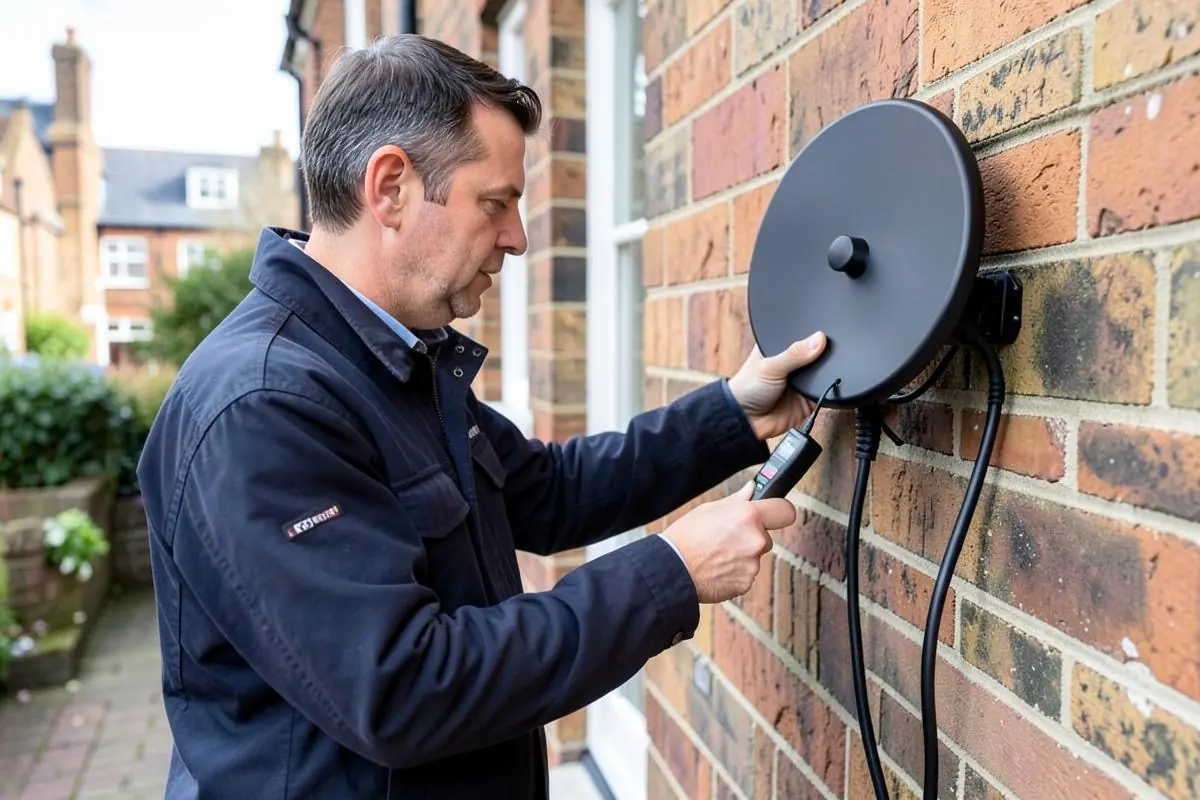
A dish is only as good as its aim and its sightline. We find a mounting position with a genuinely clear view to the south, align it on a meter to the peak rather than to the first lock, and cable it so it survives a decade of London weather.
- Peaked on a meter
- Discreet siting
- Twin or quad feeds
0.1°
Alignment tolerance
North & North West London
Sightline first, bracket second
Satellite reception needs an unobstructed view of a specific point in the southern sky. In this part of London that view is regularly interrupted by mature trees, rear extensions, mansion blocks and the slope of the ground itself, so the first thing we do is establish where a clear line actually exists — sometimes a chimney, a gable, a flat roof or a garden pole rather than the obvious side wall.
Then it's about accuracy. A dish that merely locks on will drop out in heavy rain; a dish peaked properly on a meter, with the LNB skew set correctly, holds a picture through weather that knocks the sloppy installs out. We use the smallest dish that gives sensible margin, which usually means a tidier result too.
Cabling is where cheap installations betray themselves. We use satellite-grade double-screened coax, keep runs short and straight, weatherproof every outdoor connection, and bring the cable in through a sealed entry point rather than a window frame.
What the job includes
Included in a satellite installation
Sightline survey
We check the line to the satellite arc from several positions before choosing where the dish goes.
Correct dish size
Sized for real margin at your address, so heavy rain doesn't take the picture with it.
Metered alignment
Elevation, azimuth and LNB skew set to the measured peak, not just to a signal lock.
Single to quad LNB
One feed or four, so extra receivers and recorders can be added without a second dish.
Sealed cable entry
Weatherproofed joints, sleeved and sealed wall entry, cable clipped along mortar lines.
Set-up and test
Receiver installed and tuned, transponder readings recorded, everything demonstrated before we go.
How it works
Satellite dish installation: from your first message to a finished job
- 01
Tell us what you watch
UK services, European channels or a specific satellite — it changes the dish size and the aim.
- 02
Find the sightline
On arrival we check clear views and confirm the mounting position and price with you.
- 03
Mount and align
Bracket fixed into sound masonry, dish peaked on a meter, LNB skew set.
- 04
Cable, tune, test
Cable run and sealed, receiver tuned, readings logged and left with you.
Questions we get asked
Satellite dish installation — the details
Can you put the dish somewhere less visible?
Usually yes — rear elevations, side returns, flat roofs and chimney mounts all work if the sightline holds. We'll show you the options and what each one costs in signal margin.
Will trees block the signal?
Wet leaves absorb satellite signal badly, so a line that works in winter can fail in June. We plan around foliage rather than aim through it.
How many TVs can one dish feed?
A quad LNB feeds four tuners directly, and more with the right multiswitch. Tell us how many rooms and recorders you want and we'll size it once.
Do you install on flats and mansion blocks?
Where the lease and managing agent permit an external fixing, yes. Where they don't, we look at the communal satellite system or an indoor alternative.
Can you re-use my old dish?
Often the bracket and dish are sound and only the LNB and cable need renewing, which keeps the cost down. We'll assess it on site.
Related work
Satellite repairs
No signal, rain fade and failed LNBs traced and repaired on the first visit.
Foreign language satellite
European, Arabic, Turkish, Asian and Polish satellite systems installed and aligned.
Sky & Freesat set-up
Dish work, multi-room feeds and set-up for Sky, Freesat and Freeview boxes.
Local pages
- Hampstead
- Belsize Park
- Highgate
- Camden Town
- Primrose Hill
- Kentish Town
- Swiss Cottage
- St John's Wood
- Golders Green
- West Hampstead
- Kilburn
- Finchley
- Muswell Hill
- Crouch End
- Archway
- Islington
- Hendon
- Mill Hill
- Willesden
- Queen's Park
Free advice, no obligation
Tell us about the satellite dish installation you need.
Speak to an engineer on WhatsApp — Mon–Sat 8am–8pm, Sun 9am–5pm. We cover North & North West London and most jobs are finished in a single visit.