
CCTV repairs & installation · NW3
CCTV repair and installation in Hampstead
CCTV repairs on any make — cameras offline, systems not recording, apps that will not connect, poor night images — plus new installations. Discreet CCTV for Hampstead houses — cameras sited for footage you can actually use, cabled so nothing shows on a protected elevation.
- CCTV repairs, any make
- Local recording, no subscription
- Established 1997
NW3
Local postcode
CCTV repairs and installation in Hampstead's conservation streets
Most Hampstead briefs start with the front door, the side return and the garden gate, because that is where deliveries, gates and boundary access all happen. We survey those approaches at eye height before quoting, since a camera that sees the top of somebody's head is no use to anyone.
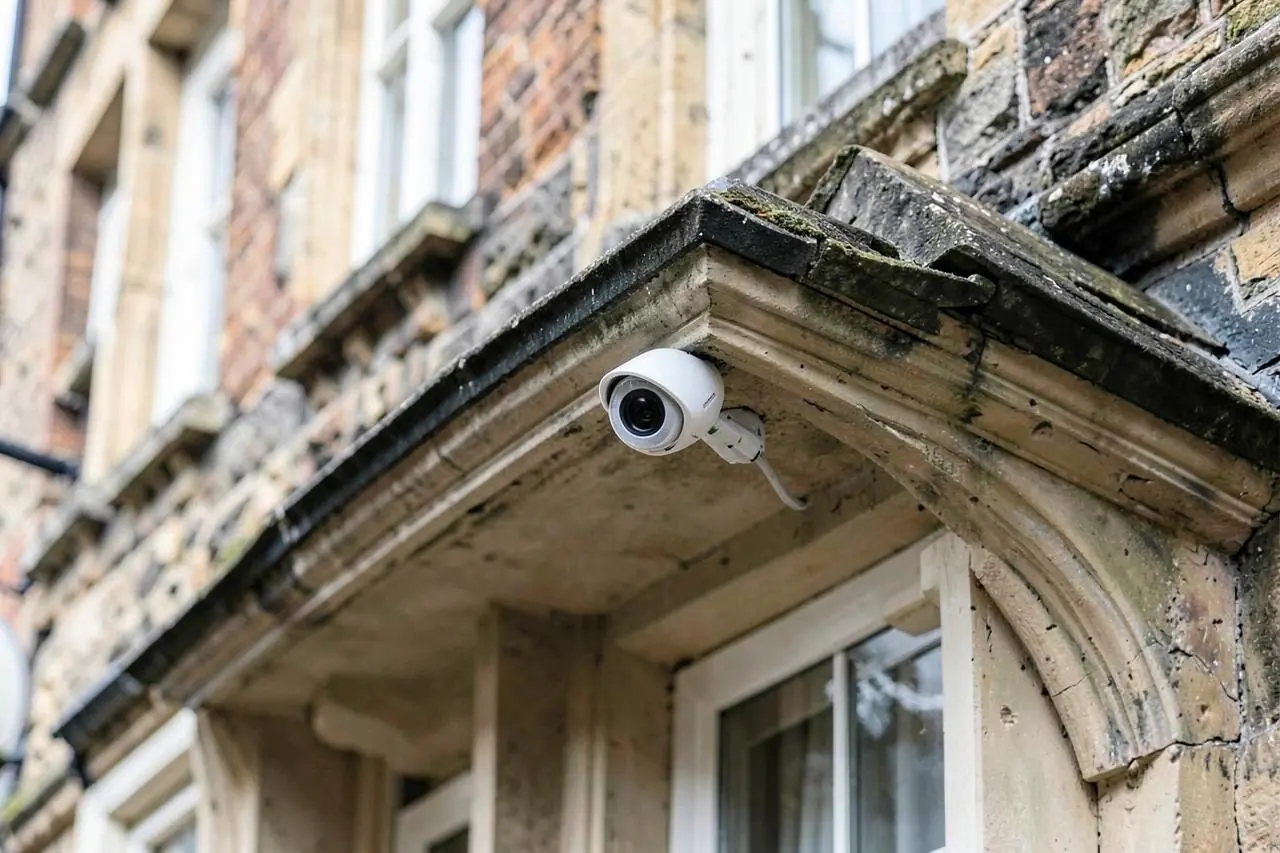
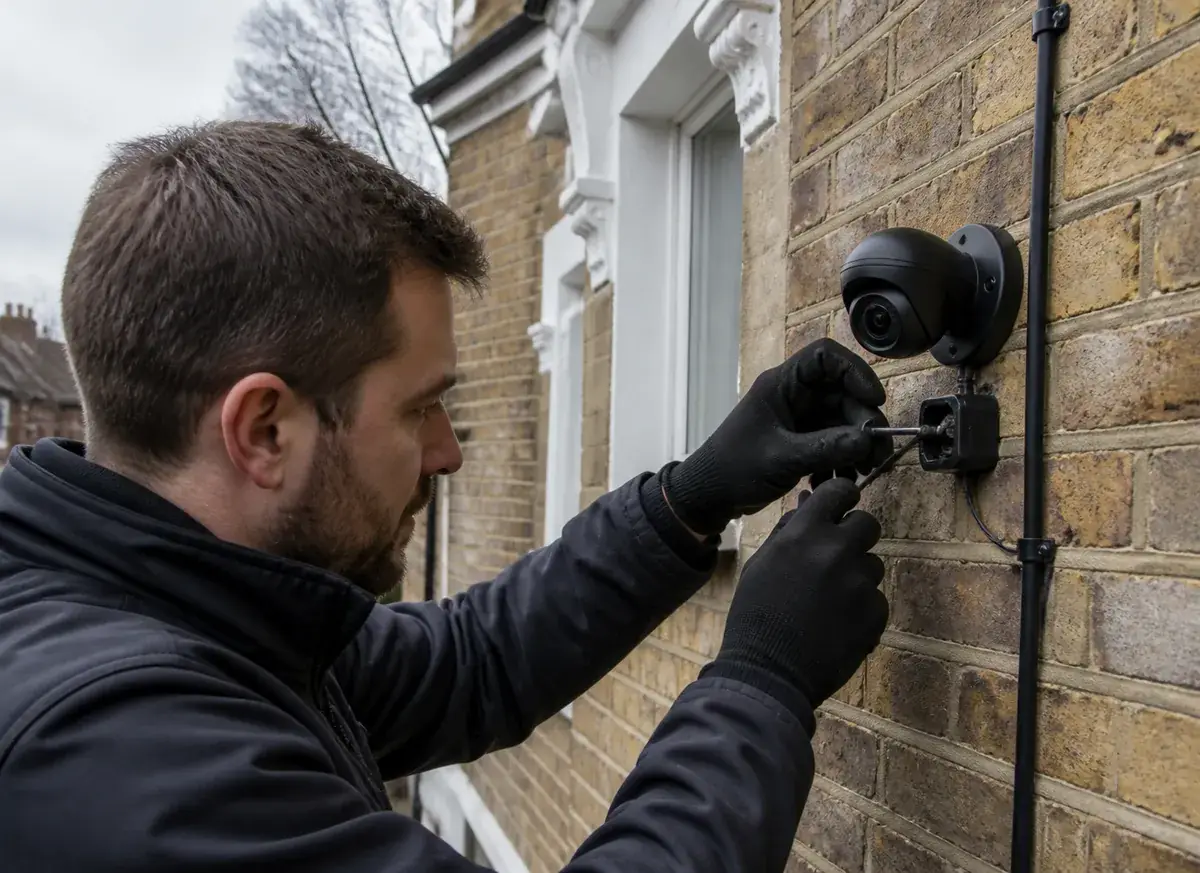
Cable routes matter more here than the cameras. On listed and conservation-area properties we run everything internally where possible, use existing chases and soffit lines, and colour-match brackets so the installation reads as part of the building rather than bolted onto it.
Hampstead's older stock runs from double-fronted Georgian and Victorian houses on Flask Walk and Well Walk to villas around Frognal and Redington Road, many set behind brick walls or hedging with a side return running to a rear garden. Steep, narrow streets such as Holly Hill and Christchurch Hill mean parking and pedestrian sightlines are tight, so a camera pointed straight down a pavement often catches passers-by rather than the actual approach. Basements and lower-ground flats add a second entrance below street level that owners frequently forget to cover, and mature front gardens can block a porch camera's view of the gate entirely.
How we design a Hampstead system
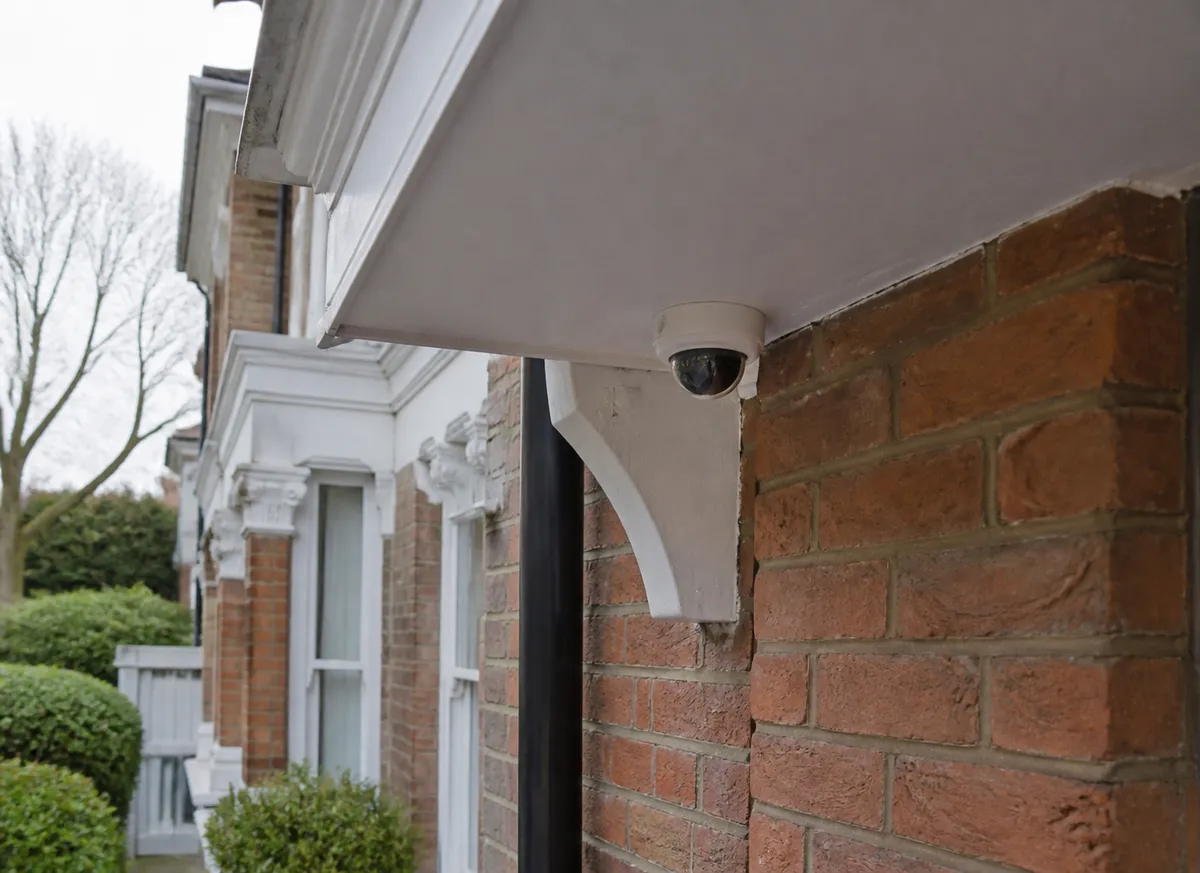
On a period façade the usual fix is a small camera under the eaves or on the door canopy rather than a bracket drilled into dressed stone or render that a conservation officer would notice. We route cable through an existing airbrick, a redundant meter box, or inside a downpipe rather than surface-clipping across brickwork, and where the front is genuinely untouchable we run internally through the loft and drop down inside a stud wall to a low-level faceplate near the door. This keeps the elevation looking exactly as it did before the job and avoids the repeated re-drilling that damages soft London stock brick over time.
Frognal and the roads off Redington Road often have long rear gardens backing onto other gardens or a mews, and that boundary is usually where an intruder actually comes from rather than the front gate. A camera on the rear elevation angled along the garden wall, set higher than head height and slightly downward, covers the fence line without looking into a neighbour's windows. Cabling to a rear position usually runs through the loft and down an internal wall or via the side return conduit already carrying gas and water pipework, which avoids a visible cable run down a rendered side elevation.
Recorders in these houses are best kept off the ground floor entirely — a cupboard under the stairs or a loft hatch keeps a hard drive away from flooding risk in houses with older lead plumbing and the odd historic leak. We size storage on how many cameras are recording continuously versus on motion only; a four-camera house recording continuously in colour at night typically needs a multi-terabyte drive to hold two to three weeks, more if the household wants a longer look-back. A wired network back to the router, rather than relying on Hampstead's mix of thick walls and patchy Wi-Fi, keeps remote viewing reliable.
Typical Hampstead systems
What we usually fit in Hampstead
- Four-camera system covering front door, drive, side gate and rear garden
- Recorder hidden in a cupboard or plant room with remote phone access
- Video door station tied into the same system
- Night-capable cameras for unlit garden boundaries
Security work in Hampstead
Discreet cameras and tidy entries in Hampstead
Camera plan
Where the cameras go on a Hampstead property
Every survey is different, but these are the positions that earn their place most often here, and why we specify them.
| Position | Why it matters |
|---|---|
| Front door canopy or under the eaves | Covers callers and deliveries face-on at a sensible height without a visible bracket on the main façade, which conservation officers generally accept without objection. |
| Side return at the top of the passage | The side return is usually the only route from front to back garden, so one camera here captures anyone moving around the side of the house. |
| Rear elevation looking along the garden wall | Covers the boundary fence and rear gate where most break-ins actually happen, angled to avoid neighbouring windows. |
| Basement or lower-ground entrance | Below-street flats and tradesman's entrances are often missed entirely by a single front camera and need their own dedicated view. |
| Driveway or gate pillar where a drive exists | On the wider plots off Redington Road a pillar-mounted camera reads number plates and faces as vehicles slow to enter, rather than a wide shot from the house. |
CCTV repairs in Hampstead
Faults we fix on existing Hampstead systems
- Old analogue cameras on Victorian bay windows aimed too high, showing roofline and sky instead of the path below
- Cable runs stapled across render on the front elevation that have cracked and let water in behind the finish
- Basement flat entrances left completely uncovered by systems installed for the house above
- Recorders left in damp cellars where older properties have a history of minor flooding, causing drive failures
- Wi-Fi cameras dropping out through thick solid-brick party walls, leaving gaps in the recording
Cameras showing no signal, a recorder that has stopped saving footage, remote viewing broken after a router change, water in a cable joint, a fogged dome or night images ruined by glare — these are all repairs rather than reasons to replace a system.
We repair and take over CCTV whoever installed it, any make. In many cases a re-aim, a new hard drive, a resealed cable entry or one replacement camera brings a Hampstead system back to useful life for a fraction of a full replacement, and if a repair genuinely is not worth the money we will tell you before you spend it.
How we specify
Resolution, storage and night performance
- Framing before resolution. A camera set at the right distance and height on a 4MP sensor beats an 8MP camera pointed vaguely at a garden.
- Recorder sized for the footage you want to keep — typically two to four weeks continuous, longer if we set motion-only recording on quieter views.
- Night performance chosen against the light we actually measure on site, so cameras are not relying on a distant street lamp.
- Recording stays local, so a broadband outage never loses evidence. Internet is only for viewing and alerts on your phone.
- Cable, glands and brackets rated for outdoor use, with sealed entries so water cannot track back into the housing.
What the job involves
Survey, install, handover
- 1. Survey. We walk the approaches with you, check sight lines at head height, measure light levels and agree camera positions and the recorder location before quoting.
- 2. Cabling. Routes are planned to keep the outside of the building clean — internal runs, existing chases, soffit lines and external-grade cable where it cannot be avoided.
- 3. Commissioning. Each camera is focused and aimed on the recorded image, motion zones are set to your property, and the recorder is configured for the retention you want.
- 4. Handover. We set up phone access, test it from outside your own network, and show you playback and how to export a clip before we leave.
Privacy and the rules
Keeping a domestic system on the right side of it
Home CCTV that captures anything beyond your own boundary brings data protection duties with it. In practice that means aiming cameras at your own approaches, masking a view where it unavoidably clips a neighbour's window or garden, keeping footage no longer than you need it, and being able to hand over a clip when it is properly requested.
For communal areas in a block, a shared house or business premises, signage telling people cameras are in use is expected, and access to footage should sit with a named person rather than everybody. We set systems up that way as standard and will put a coverage plan in writing when a freeholder, managing agent or insurer asks for one.
Security services in Hampstead
Cameras, intercoms and cabling across Hampstead
CCTV installation & repair
CCTV repairs, camera and recorder faults fixed, plus new systems positioned for useful footage.
Read moreVideo doorbell fitting
Doorbells wired to a permanent supply and connected to WiFi that actually reaches the door.
Read moreDoor entry & access control
Video intercoms, audio handsets and fob access for houses and mansion blocks.
Read moreNetwork & data cabling
Ethernet points, patch panels and structured cabling run neatly through period homes.
Read moreHampstead questions
CCTV answers for Hampstead
Do you repair CCTV in Hampstead, or only install new systems?
Both, and repairs are the bulk of what we do. We fix cameras, recorders, cabling and remote viewing on systems of any make, including ones installed by other companies.
One camera has gone black or says no signal — can it be fixed?
Usually yes. It is most often a wet or damaged cable joint, a failed power supply or a single dead camera, and each of those can be replaced on its own without touching the rest of the system.
My recorder has stopped saving footage. Is that a repair?
Almost always. Hard drives wear out with continuous recording, and schedules sometimes get changed by accident. We fit a new drive, set the retention you want and test playback with you.
Can you fix CCTV that stopped working on my phone?
Yes. Remote viewing usually breaks after a broadband, router or password change. We reconnect the recorder, re-set the app and test it from outside your own network so we know it truly works.
Will CCTV be allowed on a listed Hampstead house?
In most cases yes, provided fixings are minimal and discreet. We plan positions that avoid decorative stonework and keep cabling internal, and we will tell you honestly if a position looks like it needs consent.
Can I watch the cameras when I'm away?
Yes. We set up secure phone and tablet access, show you how playback works, and check it from outside your own network before we leave.
How long is footage kept?
It depends on camera count and resolution. We usually size the recorder for two to four weeks of continuous recording and set motion events so the clips you need are easy to find.
Do I need permission to fit CCTV on a listed or conservation-area house in Hampstead?
Many Hampstead streets sit within a conservation area, and some houses are listed. Small, discreetly sited cameras rarely need consent, but altering a listed façade or adding visible trunking can. We plan positions and cable routes to avoid the issue and flag any case where we think consent is genuinely needed.
Can you cover a garden that backs onto a communal garden or square?
Yes. Several Hampstead gardens back onto shared or communal land, so we angle rear cameras to cover your own boundary and gate rather than sweeping across the shared garden itself, which keeps footage focused on your property and avoids capturing more of the communal space than needed.
How long is footage normally kept?
Most households keep footage for one to four weeks depending on storage size and how many cameras record continuously. We size the hard drive to the household's preference at survey stage rather than fitting a fixed default.
Can a new system use my existing cabling?
Sometimes. Older coax runs can often carry a new HD signal if the cable itself is sound, which saves reopening walls. We test existing cable during the survey and only replace runs that have degraded or don't reach a useful position.
Free advice, no obligation
Tell us what your Hampstead cameras are doing. We'll tell you the fix.
Speak to an engineer on WhatsApp — Mon–Sat 8am–8pm, Sun 9am–5pm. We cover North & North West London and most jobs are finished in a single visit.