
CCTV repairs & installation · NW5
CCTV repair and installation in Kentish Town
CCTV repairs on any make — cameras offline, systems not recording, apps that will not connect, poor night images — plus new installations. Practical CCTV for Kentish Town houses, flats and HMOs — entrances, bin stores and rear access covered without fuss.
- CCTV repairs, any make
- Local recording, no subscription
- Established 1997
NW5
Local postcode
CCTV repairs and installation in Kentish Town
Kentish Town work splits between owner-occupied terraces and let properties. For houses we cover the front approach and the rear return; for shared houses and small blocks the priority is the entrance door, the hallway and the bin or bike store, because that is where deliveries and cycles go missing.
We keep systems simple to live with: local recording, clear phone access and motion zones that ignore the pavement so you are not scrolling through hundreds of passing pedestrians.
Kentish Town's terraces along Fortess Road, Islip Street and the streets off Leighton Road are mostly Victorian two- and three-storey houses split into flats, many with a shared front door onto the pavement and a narrow return passage leading to a rear yard or small garden. Bin storage is often crammed against the front wall or down the side return, and rear access frequently backs onto a mews, mutual lane or the railway embankment near the Overground and Northern line tracks. Front doors sit close to the road, so cameras need care to avoid simply filming passers-by on a busy pavement.
How we design a Kentish Town system
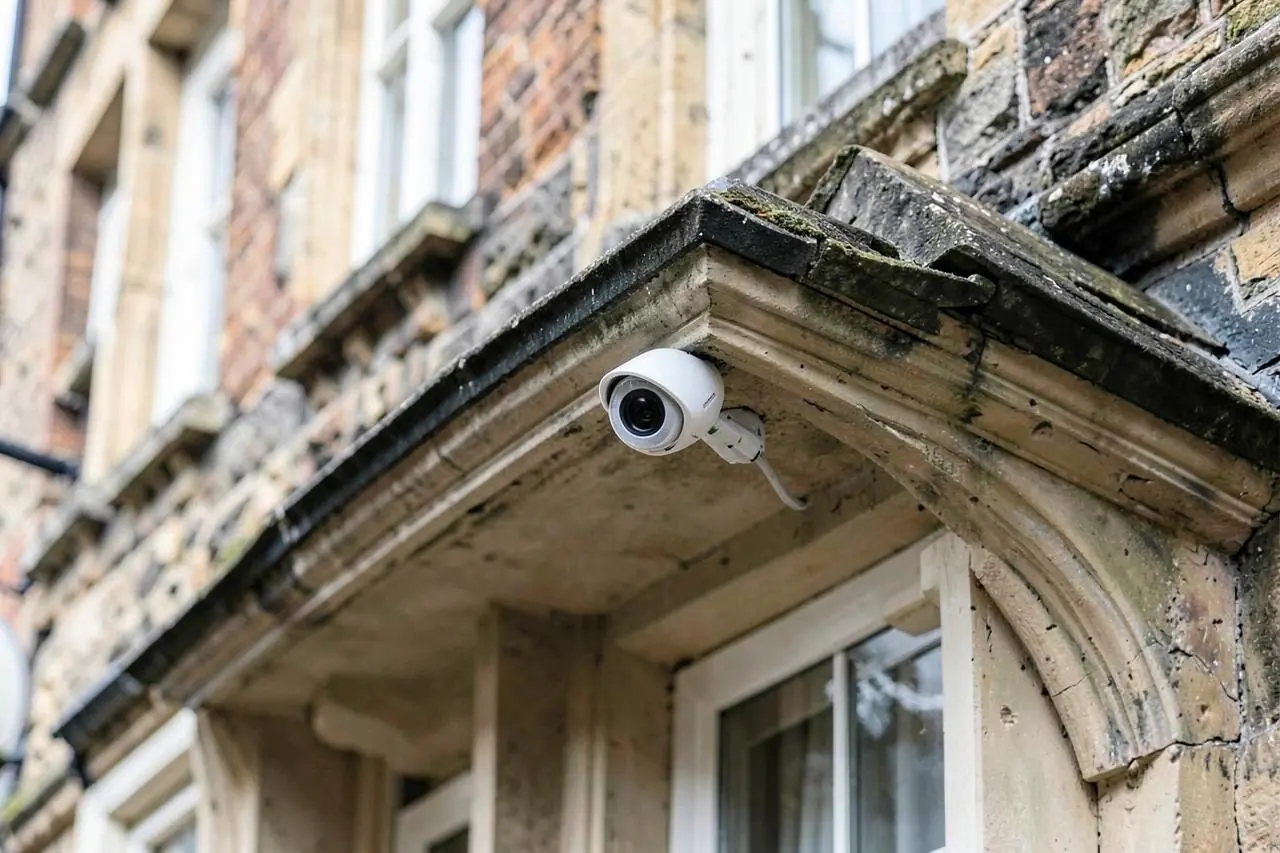
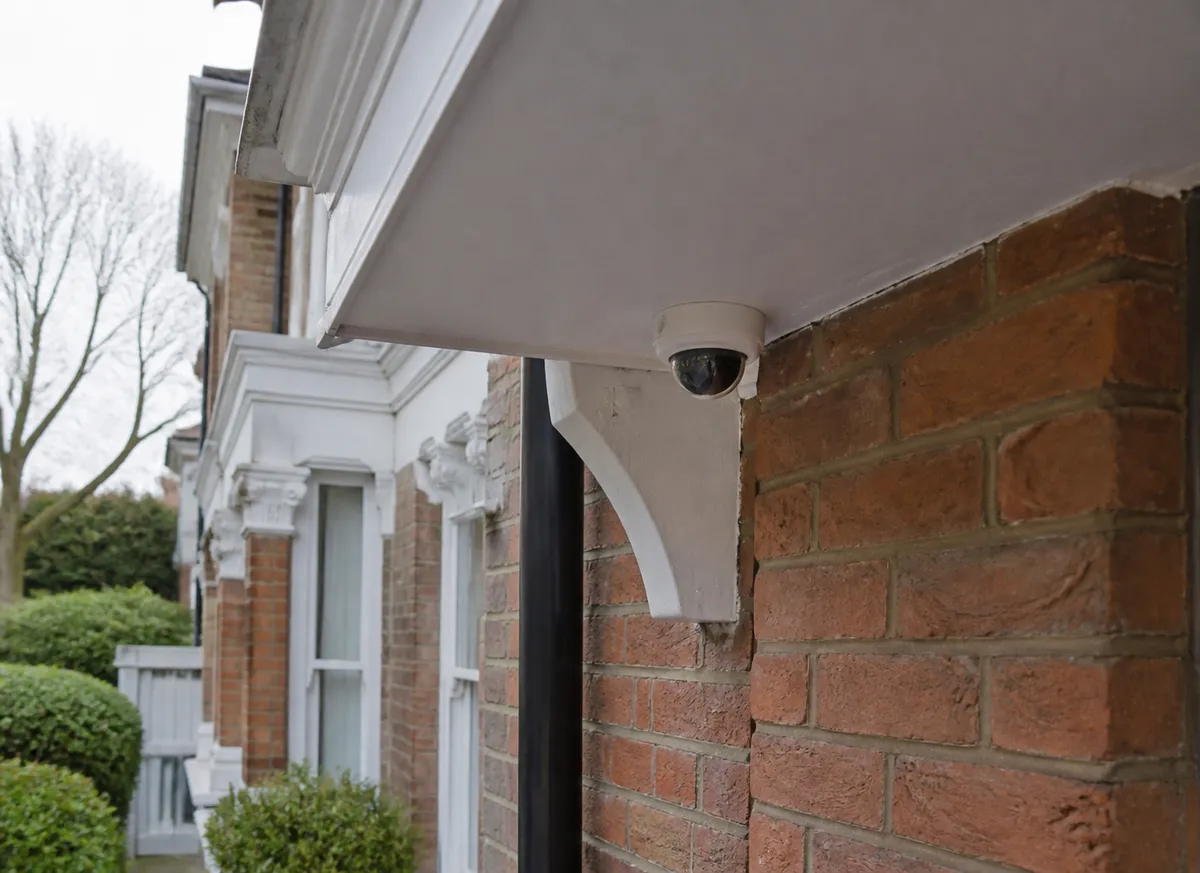
On a shared Kentish Town terrace the front camera usually goes above the communal door lintel, angled down the steps rather than out across the street, keeping the field of view on the doorstep, post table and bin area rather than sweeping the pavement or neighbouring windows. Cable is run inside the porch void or along the underside of a bay window ledge, then dropped through a small core-drilled hole into the hallway, avoiding the original cornicing that many of these conversions still carry. Where the property is split into leasehold flats, the freeholder or managing agent should confirm who owns the entrance before drilling.
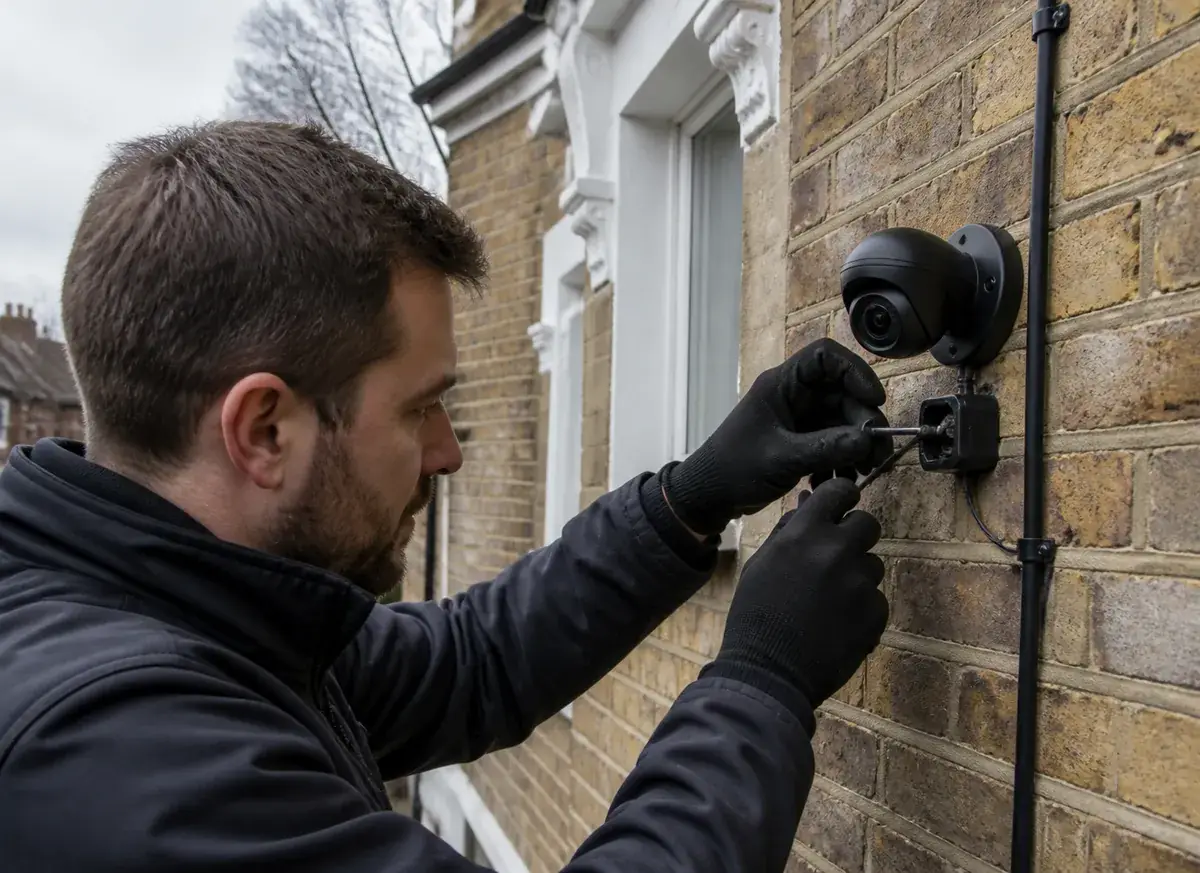
Rear coverage is the harder problem here because these yards back onto mutual lanes shared with two or three other households, so a camera on next door's wall or a shared shed can raise boundary questions. We prefer fixing to the subject property's own rear elevation or soffit, angled down into the yard and gate rather than across the neighbour's garden, and we keep the lens height around 2.4-2.8m so it's above reach but still captures faces at the gate rather than just the tops of heads. Cable is run in white mini-trunking down the rear wall to a recorder in a cupboard or loft space near the consumer unit.
Because several of these houses are close to the railway, night-time light spill from platform lighting can help but also causes glare on cheaper sensors, so we specify cameras with real wide dynamic range rather than relying on IR alone. A 4-channel recorder with a 2TB or 4TB drive comfortably covers front door, side return, rear yard and a shed or bike store at typical Kentish Town resolutions; where the household wants phone access we run a wired network cable to the recorder rather than trusting a shared building Wi-Fi signal that often struggles through solid Victorian party walls.
Typical Kentish Town systems
What we usually fit in Kentish Town
- Entrance and hallway cameras for a shared house
- Bike store camera with night coverage
- Two-camera house system, front and rear
- Older analogue kit replaced with clearer digital cameras
Security work in Kentish Town
Discreet cameras and tidy entries in Kentish Town
Camera plan
Where the cameras go on a Kentish Town property
Every survey is different, but these are the positions that earn their place most often here, and why we specify them.
| Position | Why it matters |
|---|---|
| Above communal front door | Covers the doorstep, post area and anyone approaching the shared entrance without pointing the lens along the public pavement. |
| Side return entry point | Narrow passages are the usual route to the rear of these terraces, so a corridor-format camera here catches anyone passing through. |
| Rear yard/garden, on the house wall | Angled down into the yard and back gate, kept off the neighbour's boundary to avoid overlooking their garden. |
| Bin store or bike store | These are frequently targeted for fly-tipping or bike theft in Kentish Town's tighter yards, so a dedicated close view pays off. |
| Rear lane gate, external | Where the property backs onto a mutual lane, a gate-level camera identifies who is opening it, day or night. |
CCTV repairs in Kentish Town
Faults we fix on existing Kentish Town systems
- Cameras fixed to next door's wall on shared rear lanes off Islip Street, causing disputes when the neighbour wants it removed.
- DVRs stuffed into damp under-stair cupboards near Fortess Road that have corroded connections after a slow roof leak.
- Wi-Fi cameras that drop out whenever a resident's router is unplugged, since the whole system was never wired to its own connection.
- Old analogue cameras on 1990s coax cable that no longer match modern recorders, left running at poor resolution for years.
- Front door cameras angled straight along the pavement, picking up every passer-by rather than the doorstep itself.
Cameras showing no signal, a recorder that has stopped saving footage, remote viewing broken after a router change, water in a cable joint, a fogged dome or night images ruined by glare — these are all repairs rather than reasons to replace a system.
We repair and take over CCTV whoever installed it, any make. In many cases a re-aim, a new hard drive, a resealed cable entry or one replacement camera brings a Kentish Town system back to useful life for a fraction of a full replacement, and if a repair genuinely is not worth the money we will tell you before you spend it.
How we specify
Resolution, storage and night performance
- Framing before resolution. A camera set at the right distance and height on a 4MP sensor beats an 8MP camera pointed vaguely at a garden.
- Recorder sized for the footage you want to keep — typically two to four weeks continuous, longer if we set motion-only recording on quieter views.
- Night performance chosen against the light we actually measure on site, so cameras are not relying on a distant street lamp.
- Recording stays local, so a broadband outage never loses evidence. Internet is only for viewing and alerts on your phone.
- Cable, glands and brackets rated for outdoor use, with sealed entries so water cannot track back into the housing.
What the job involves
Survey, install, handover
- 1. Survey. We walk the approaches with you, check sight lines at head height, measure light levels and agree camera positions and the recorder location before quoting.
- 2. Cabling. Routes are planned to keep the outside of the building clean — internal runs, existing chases, soffit lines and external-grade cable where it cannot be avoided.
- 3. Commissioning. Each camera is focused and aimed on the recorded image, motion zones are set to your property, and the recorder is configured for the retention you want.
- 4. Handover. We set up phone access, test it from outside your own network, and show you playback and how to export a clip before we leave.
Privacy and the rules
Keeping a domestic system on the right side of it
Home CCTV that captures anything beyond your own boundary brings data protection duties with it. In practice that means aiming cameras at your own approaches, masking a view where it unavoidably clips a neighbour's window or garden, keeping footage no longer than you need it, and being able to hand over a clip when it is properly requested.
For communal areas in a block, a shared house or business premises, signage telling people cameras are in use is expected, and access to footage should sit with a named person rather than everybody. We set systems up that way as standard and will put a coverage plan in writing when a freeholder, managing agent or insurer asks for one.
Security services in Kentish Town
Cameras, intercoms and cabling across Kentish Town
CCTV installation & repair
CCTV repairs, camera and recorder faults fixed, plus new systems positioned for useful footage.
Read moreVideo doorbell fitting
Doorbells wired to a permanent supply and connected to WiFi that actually reaches the door.
Read moreDoor entry & access control
Video intercoms, audio handsets and fob access for houses and mansion blocks.
Read moreNetwork & data cabling
Ethernet points, patch panels and structured cabling run neatly through period homes.
Read moreKentish Town questions
CCTV answers for Kentish Town
Do you repair CCTV in Kentish Town, or only install new systems?
Both, and repairs are the bulk of what we do. We fix cameras, recorders, cabling and remote viewing on systems of any make, including ones installed by other companies.
One camera has gone black or says no signal — can it be fixed?
Usually yes. It is most often a wet or damaged cable joint, a failed power supply or a single dead camera, and each of those can be replaced on its own without touching the rest of the system.
My recorder has stopped saving footage. Is that a repair?
Almost always. Hard drives wear out with continuous recording, and schedules sometimes get changed by accident. We fit a new drive, set the retention you want and test playback with you.
Can you fix CCTV that stopped working on my phone?
Yes. Remote viewing usually breaks after a broadband, router or password change. We reconnect the recorder, re-set the app and test it from outside your own network so we know it truly works.
Can you stop it recording all the passers-by?
Yes. We set motion detection zones to your own property and mask the pavement, so alerts stay meaningful.
Do you fit systems for landlords?
Regularly. We keep cameras in communal areas only, never inside a tenant's room or a private kitchen, and set viewing access accordingly.
How much disruption is there?
Most two to four camera installations are a day, sometimes less. We tell you which rooms we need access to before we start.
Our house in Kentish Town is split into three flats — who needs to agree to a shared CCTV system?
Where there's a freeholder or managing agent, they should sign off on any camera covering communal areas such as the front door or hallway, and it's worth telling the other leaseholders what's being installed and why. Cameras covering only your own flat's demise are more straightforward, but shared entrance coverage benefits from being agreed upfront to avoid later disputes.
Can you avoid filming the neighbour's yard from our rear camera?
Yes — this is standard practice on Kentish Town's narrow rear yards. We angle the lens down into your own boundary and gate, use privacy masking within the recorder software to blank out any unavoidable overlap, and check the live view on-site before fixing the bracket permanently.
How disruptive is fitting a wired system into an old Kentish Town terrace?
Cable is generally run through existing gaps — under floorboards, up soil pipe ducts, through loft spaces — so drilling is kept to small core holes at entry and exit points. Most installs are finished within a day with minimal mess, and we make good any holes before leaving.
Free advice, no obligation
Tell us what your Kentish Town cameras are doing. We'll tell you the fix.
Speak to an engineer on WhatsApp — Mon–Sat 8am–8pm, Sun 9am–5pm. We cover North & North West London and most jobs are finished in a single visit.